
Leverage and the Down Payment: Why Small Price Moves Matter
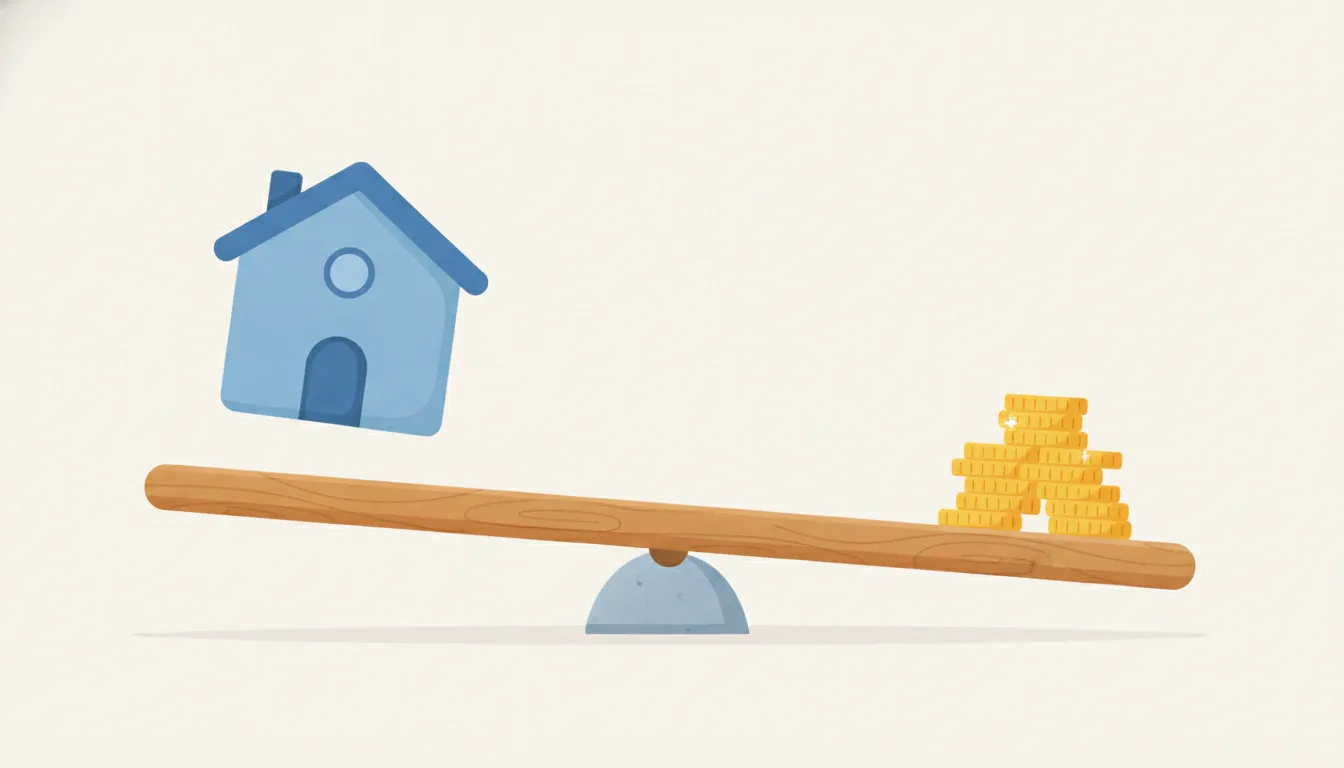
Why does a small change in a home's price feel so large next to the money a household actually put in? Because most homes are bought mostly with borrowed money. The price change applies to the whole home, but it is measured against only the down payment. That magnifies a rise and a fall alike.
Key takeaways
- Leverage means using borrowed money to control an asset worth more than the cash you put in.
- In a hypothetical purchase with 10 percent down, a 5 percent price rise equals a 50 percent change on the down payment, and a 5 percent fall is a loss of the same size.
- A larger down payment reduces the swing, since the same dollar change is spread over more of your own money.
- The percentage change on your equity usually shrinks as equity grows, because the same price move is measured against a bigger base.
- A high percentage on equity is not the same as profit, since interest, taxes, insurance, upkeep and selling costs all reduce the result.
Leverage in plain terms
Leverage means using borrowed money to control something worth more than the cash you contribute. In a home purchase, the Consumer Financial Protection Bureau explains, you put a percentage of the home's value down and borrow the rest through a mortgage. Equity is what the property is currently worth minus what is owed on it.
At the start, equity is roughly the down payment. As the price moves, equity moves with it, dollar for dollar.
A hypothetical with 10 percent down
Suppose a household buys a $400,000 home with 10 percent down, or $40,000, and borrows $360,000.
- If the price rises 5 percent, the home is worth $420,000. That is a $20,000 change, equal to 50 percent of the $40,000 down payment.
- If the price falls 5 percent, the home is worth $380,000. The same $20,000 change now removes half of the down payment on paper.
- If the price falls 10 percent, the decline is $40,000, which equals the whole down payment.
The numbers are invented for illustration. Real prices depend on location, timing and the condition of the property, and they can rise, fall or stay flat.
What a larger down payment changes
Now suppose the same household puts down 20 percent, or $80,000, and borrows $320,000. A 5 percent price move is still $20,000, but it is only 25 percent of the down payment instead of 50 percent. A 10 percent drop is $40,000, or half of the down payment rather than all of it.
A smaller down payment brings its own trade-offs. The CFPB notes that with less than 20 percent down, a buyer likely needs to pay for mortgage insurance, and that low-down-payment options can mean higher costs over the life of the loan. A larger down payment, in turn, uses more cash that might otherwise serve as a reserve for repairs or emergencies.
Why the percentage fades
The big percentages describe the first year or so. As equity grows, through principal payments and price increases, the same dollar change is measured against a bigger base.
Continue the example. Say the price rises 3 percent in year one, to $412,000, and the household pays down about $4,000 of principal. Equity would be about $56,000. If the price rose another 3 percent, or about $12,360, that equals roughly 22 percent of equity, well below the 30 percent a 3 percent rise would equal on the original $40,000.
What the percentage leaves out
A high percentage on the down payment can sound like a profit. It is not, because it ignores what it costs to hold the home.
At an assumed 6.5 percent rate on a 30-year loan of $360,000, about $23,300 of the first year's payments would go toward interest, and only about $4,000 toward principal. A 3 percent price rise in the same year is about $12,000. That comparison is not a verdict, since living in a home has value that rent would also have bought, but it shows why the percentage alone does not describe the outcome.
Property taxes, insurance, maintenance and the costs of buying and selling also reduce the result. The CFPB cautions against depending on a quick sale to exit a mortgage, especially in the early years, and recommends budgeting for upkeep and repairs.
Questions to ask about leverage
- How large a price drop would erase my equity, and could I stay in the home if that happened?
- How does the down payment I am considering change my monthly cost, including any mortgage insurance?
- What cash reserve would remain after the down payment and closing costs?
- When a chart reports a return, is it measured against the full price of the home or against the cash put in?
- If I might need to move within a few years, what would selling costs do to the result?
Leverage is neither good nor bad on its own. It is a way of making outcomes larger in both directions, and knowing which direction the household can afford to be wrong is part of understanding the choice.
Common questions
What does leverage mean when buying a home?
It means paying only part of the price in cash and borrowing the rest, so changes in the home's value apply to the whole price but are measured against a smaller amount of your own money. That can magnify gains and losses alike.
Can a home's price fall enough to wipe out a down payment?
It can. In the hypothetical example, a 10 percent price drop on a home bought with 10 percent down erases the down payment on paper, before any selling costs. The Consumer Financial Protection Bureau notes that if market value decreases, equity decreases too.
Is a high return on my down payment the same as making a profit?
No. The percentage describes only the price change against the cash put in. Interest, property taxes, insurance, upkeep and the costs of buying and selling all reduce what a household actually keeps.
Explore your next step
Sources and further reading
From the Borrow Smart newsletter
NIFE provides general financial education. LendsightAI and Debt Done Date are separate for-profit partners; optional services may have a fee.