
Does Rising Rent Make It Harder to Save for a Home?
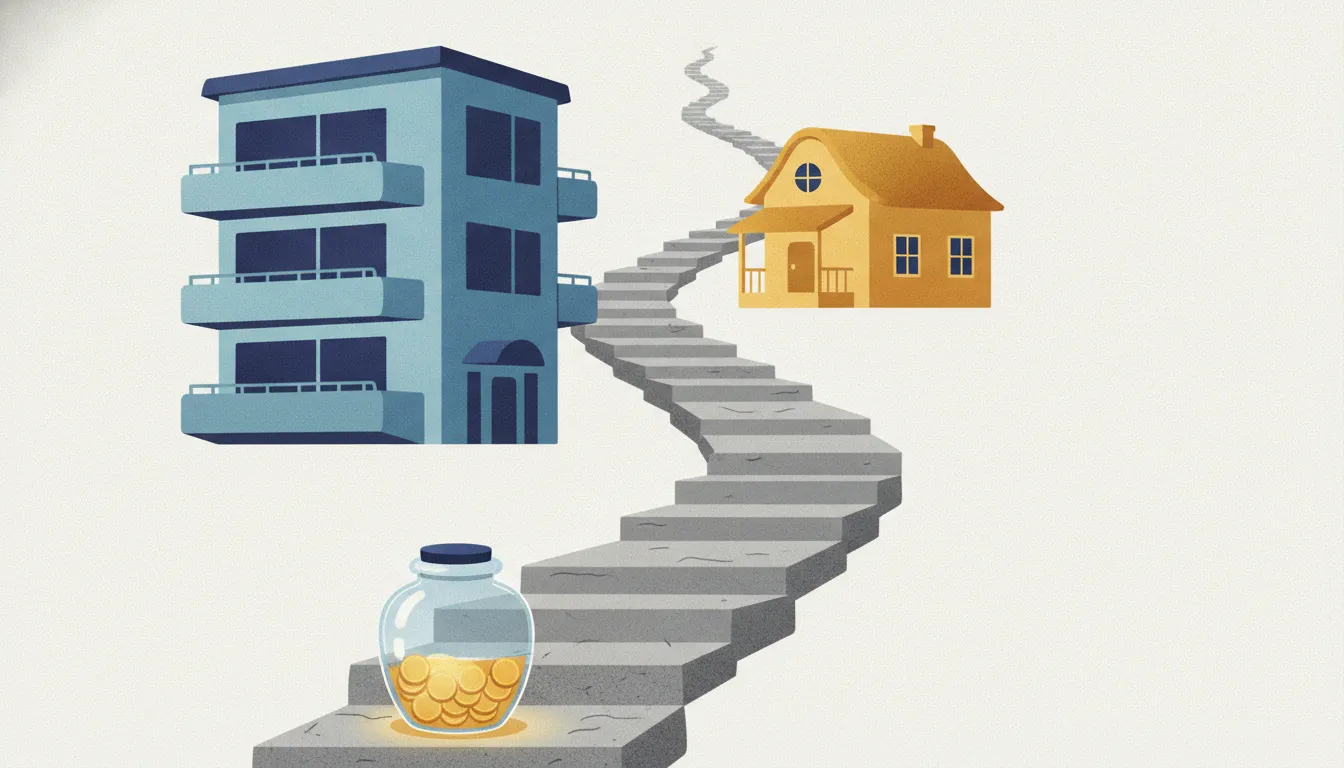
When the rent goes up and the paycheck does not, something else gives. Often it is the savings. For households hoping to buy a home someday, that raises a fair question: does rising rent make it harder to get there? For many the answer is yes, because rent and a down payment draw on the same pool of money. But it is not the whole picture, and the size of the effect depends on the numbers.
Key takeaways
- Rent that rises faster than income leaves less each month for a down payment, closing costs and an emergency cushion.
- In a Federal Reserve survey of 2024, 68 percent of renters said they could not afford a down payment, the most common reason they gave.
- The same survey shows renting is not only a constraint, since 58 percent of renters said it is more convenient or flexible.
- In a hypothetical example, a 5 percent rent increase stretched a savings timeline by about seven months to about fifteen months.
- Total savings goals include more than the down payment, because closing costs and a reserve for emergencies also matter.
What renters say
The Federal Reserve surveys households each year. In its report on 2024, it asked renters why they rent rather than own, and let them choose more than one answer.
- 68 percent said they could not afford a down payment.
- 49 percent said they could not afford the monthly mortgage payment.
- 42 percent said they could not qualify for a mortgage.
- 46 percent said it is cheaper to rent.
The same survey also shows that renting is often a positive choice. About 58 percent said renting is more convenient or flexible, 47 percent said it is less financially risky, and 39 percent said they prefer to rent. In other words, rising rent does not push every renter toward the same goal. For those who do want to buy, though, the down payment stands out as the main obstacle.
Why the target is bigger than the down payment
The Consumer Financial Protection Bureau says that in most cases a down payment of at least 3 percent of the home price is needed, and many loans call for 5 percent or more. It adds that closing costs typically range from 2 to 5 percent of the price, and suggests keeping an emergency cushion of at least three to six months of expenses.
Put together, a savings goal has three parts: the down payment, closing costs and a reserve. Each of them grows with the price of the home.
A hypothetical timeline
For example, consider a household looking at a $300,000 home with monthly expenses of $3,800, including rent. These are illustrations.
- Down payment at 3 to 5 percent: $9,000 to $15,000.
- Closing costs at 2 to 5 percent: $6,000 to $15,000.
- Emergency reserve of three to six months: $11,400 to $22,800.
The total ranges from about $26,400 to $52,800. If the household saves $600 a month, that is 44 months at the low end and 88 months at the high end.
Now suppose its $1,750 rent rises 5 percent, which adds $87.50 a month. If income stays the same, monthly savings drop to $512.50. The low-end goal now takes about 52 months and the high-end goal about 103. A single rent increase added about seven or eight months to the low-end goal and about fifteen months to the high-end goal, and rent increases can repeat.
The example leaves out interest on savings, raises in pay, assistance programs and any price changes in the home itself, and each of those could shorten or lengthen the timeline.
Rent is only one side of the comparison
Looking at rent alone can mislead. Owning has its own costs that renters do not pay directly, such as property taxes, insurance and repairs. A household can compare the full monthly cost of each option, plus what it would put into savings in each case. A rent versus own calculator can help organize that comparison.
Questions to ask
- After rent and essential bills, how much do I actually save each month?
- What happens to that amount if rent rises by 3, 5 or 10 percent?
- What is the total I need, including closing costs and a cushion, and not just the down payment?
- If I stay in my current home another year, how much closer would I be?
- Is the main barrier the down payment, qualifying for a loan, or the monthly payment? Each calls for a different plan.
- Do I actually want to own, or does renting suit my plans for the next few years?
Working through these gives a renter something firmer than a vague worry. It shows how much of the timeline is controlled by rent, how much by income and how much by the goal itself.
Common questions
Does higher rent make it harder to buy a home?
For many households it does, because rent competes with saving for a down payment. In the Federal Reserve's survey of 2024, 68 percent of renters named the down payment as a reason they were not buying.
How much do I need to save to buy a home?
The Consumer Financial Protection Bureau says that in most cases a down payment of at least 3 percent is needed, with many loans requiring 5 percent or more, and closing costs typically run 2 to 5 percent of the price. It also suggests an emergency cushion of three to six months of expenses.
Is renting always a disadvantage?
Not necessarily. Many renters value flexibility and lower exposure to repair and market risk, and in the Federal Reserve's survey 47 percent said renting is less financially risky. Which option suits a household depends on its goals, timeline and local costs.
Explore your next step
Sources and further reading
From the Borrow Smart newsletter
NIFE provides general financial education. LendsightAI and Debt Done Date are separate for-profit partners; optional services may have a fee.