
Sorting Your Debts by Cost, Purpose and Monthly Weight
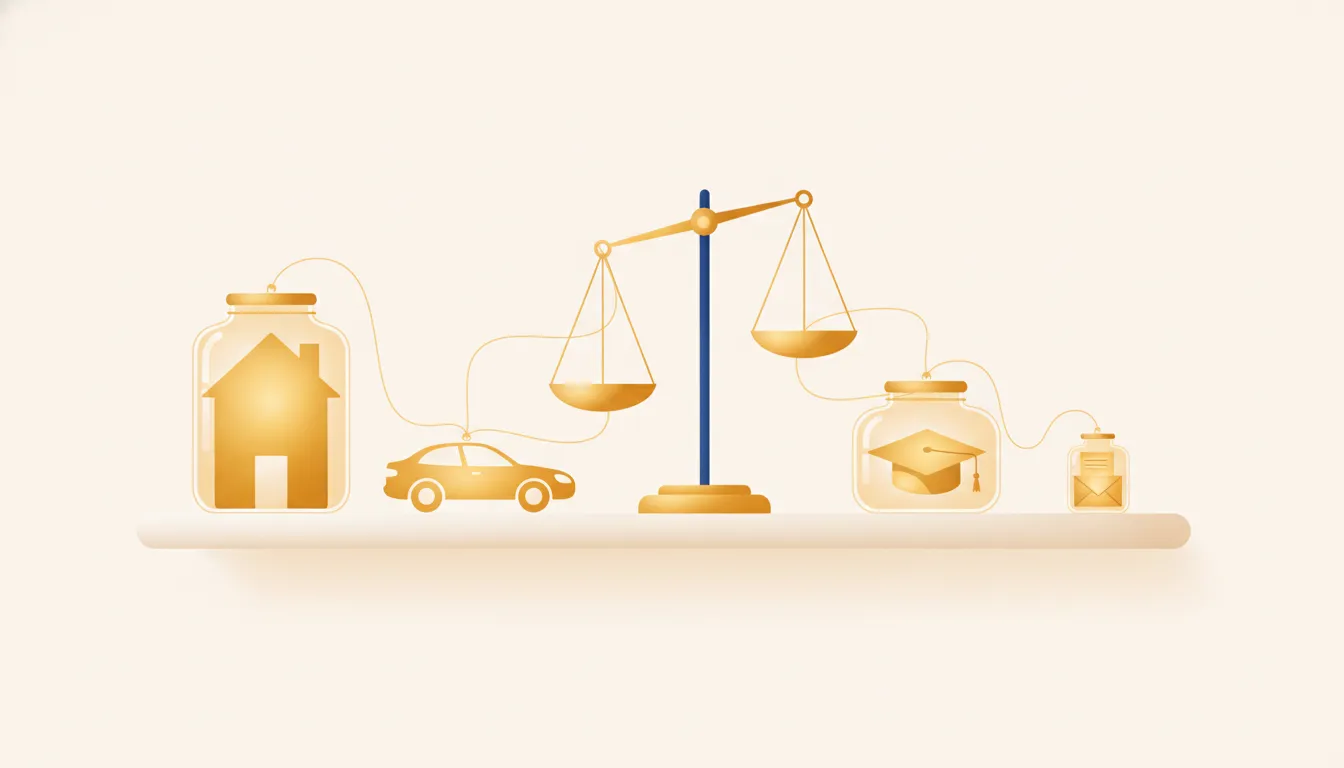
A mortgage, a car loan, student loans and a credit card balance all count as debt, but they behave very differently. Adding them into a single total hides the details that tend to matter most: what each one costs, what it paid for, and how much of each month it takes. Sorting debts along those lines can show where a household's attention may be best spent, without relying on labels.
Key takeaways
- A household total for debt hides big differences in rate, purpose, collateral and monthly payment.
- The largest balance is not always the heaviest burden, because a small high-rate balance can generate a large share of the yearly interest.
- A fixed-rate loan keeps its rate and principal and interest payment the same, while a card balance accrues interest daily unless paid in full.
- Debt-to-income ratio, which divides monthly debt payments by gross monthly income, shows how much of income is already committed.
- Labels such as good debt and bad debt can mislead, so many households compare each loan on cost, backing and cash flow instead.
Where household debt sits
The Federal Reserve Bank of New York reports that total U.S. household debt was about $18.8 trillion at the end of June 2026. Mortgages made up roughly $13.1 trillion of that, while auto loans, student loans and credit cards were each far smaller, in the range of about $1.3 to $1.7 trillion.
That is a national snapshot, not a guide to any one household. Within a single home, the largest balance and the heaviest burden can be different debts, as the example below shows.
Line one: what it costs
Interest is the price of using someone else's money, and structure matters as much as the rate.
- With a fixed-rate loan, the Consumer Financial Protection Bureau explains, the interest rate and the monthly principal and interest payment stay the same. With an adjustable-rate loan, payments can rise or fall.
- Many card issuers calculate interest daily on the average daily balance. Interest on purchases can often be avoided by paying the full balance by the due date, but not when a balance is carried.
Line two: what it financed, and what backs it
A debt can pay for something that holds value, something that wears out, a credential, or spending that has already happened. It can also be backed by collateral. A mortgage is secured by the home, which means falling behind can put the home at risk. Card balances are generally not backed by property.
Many people sort debts into "good" and "bad." The labels are popular, but they can mislead. A low-rate loan for something useful can still strain a budget, and a purchase that felt sensible can become hard to carry if income changes. Asking what each loan paid for, and what happens if it cannot be paid, is more specific.
Line three: its monthly weight
The Consumer Financial Protection Bureau defines a debt-to-income ratio as monthly debt payments divided by gross monthly income, and notes that lenders and loan products set different limits. It shows how much income is already spoken for before groceries or savings.
A worked comparison
Consider a hypothetical household with $7,500 in gross monthly income and four debts:
- Mortgage: $240,000 balance at 4 percent with 25 years left, a payment of about $1,267.
- Car loan: $18,000 at 7 percent with four years left, about $431.
- Student loans: $20,000 at 5 percent over ten years, about $212.
- Credit card: $5,000 at 24 percent, with a payment of about $150, of which roughly $100 is interest.
Together the payments are about $2,060, or roughly 27 percent of gross income.
Now compare size with interest. The mortgage is about 85 percent of the $283,000 in balances, and the card is about 2 percent. But estimating a year of interest as balance times rate gives roughly $9,600 for the mortgage, $1,260 for the car, $1,000 for the student loans and $1,200 for the card. The card, about 2 percent of the balances, produces about 9 percent of the yearly interest, and only about $50 of its payment reduces the balance.
These figures are illustrations. They ignore taxes, insurance, fees, changing rates and the fact that interest falls as balances are paid down.
Questions to ask about each debt
- What is the rate, is it fixed or adjustable, and how long does it last?
- What backs it, and what would happen if payments stopped?
- How much of monthly income does it take, and what remains?
- If income dropped, which payments would be hardest to keep up?
- Does the loan allow early payments, and are there any costs for making them?
Answers to these questions turn a single total into a map, and a map makes it easier to discuss priorities with a licensed professional.
Common questions
Is there such a thing as good debt and bad debt?
People use those labels, but they can hide important details. A loan with a low fixed rate can still strain a budget, and a purchase that seemed sensible can become hard to carry if income drops. Comparing cost, collateral and monthly payment is more informative than a label.
What is a debt-to-income ratio?
The Consumer Financial Protection Bureau defines it as your monthly debt payments divided by your gross monthly income. Different loan products and lenders have different limits.
Why can a small credit card balance matter so much?
Card interest rates are often much higher than rates on other loans, so even a modest balance can produce a large share of the interest a household pays in a year.
Explore your next step
Sources and further reading
From the Borrow Smart newsletter
NIFE provides general financial education. LendsightAI and Debt Done Date are separate for-profit partners; optional services may have a fee.