
When Your Home Is Most of Your Net Worth: Concentration Risk
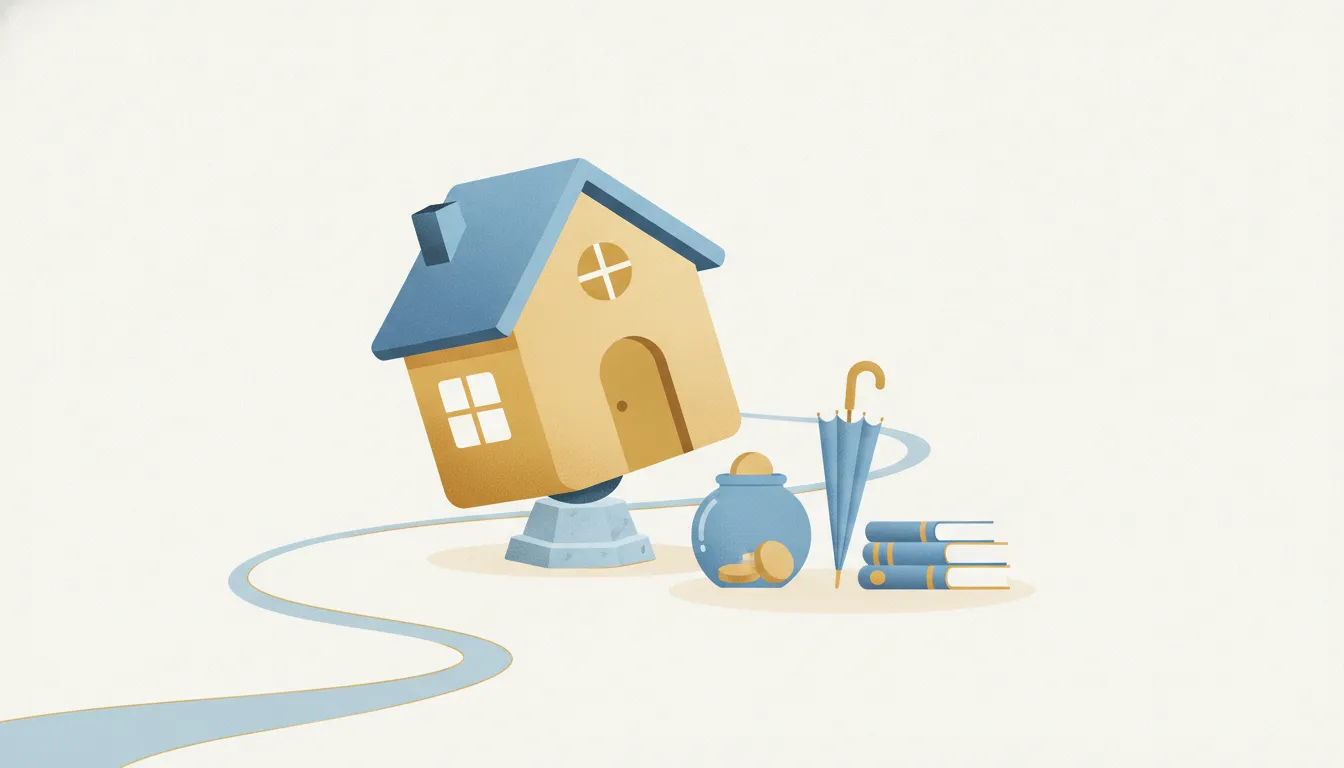
For many households, one asset towers over the rest. The home may be worth several times the savings account, and the balance on its mortgage may be the largest debt. That raises a question beyond whether owning is a good idea: what does it mean when so much of a household's wealth sits in a single property in a single place, and how can a household look at that honestly?
Key takeaways
- A home is often the biggest single item on a household's balance sheet, which means one property in one local market can drive much of its net worth.
- Because a mortgage amplifies the effect of price changes on equity, a 10 percent price drop in the example removes about 23 percent of the owner's equity.
- Home equity is hard to spend, since reaching it generally requires selling or borrowing against the home.
- The Securities and Exchange Commission describes diversification as spreading money among different investments to reduce risk, and the same idea can be applied to the household's whole balance sheet.
- Households weigh concentration against the housing, stability and family reasons for owning, and a home is a place to live as well as an asset.
What the national picture shows
The Federal Reserve Board's report on the 2025 Survey of Consumer Finances, released in October 2026, found that about two-thirds of families own a home, with an ownership rate of 65.6 percent. Among owners, the median home was worth about $375,000, and the median net housing value, meaning the home's value minus the debt secured by it, was $230,000. About 42 percent of all families had debt secured by their primary residence.
The same report shows how large housing can look next to everything else. Median net worth was $458,900 for homeowners and $10,600 for renters or other non-homeowners. Those are medians for different groups, so they cannot be divided into a share of any one family's wealth, but they give a sense of scale: for typical owners, home equity is a major piece of the total.
Why concentration matters
The Securities and Exchange Commission describes diversification as spreading money among different investments to reduce risk, noting that the right mix may help limit losses and reduce swings in returns. That guidance is about investments, but the idea applies by analogy to a household balance sheet. One house in one town is a single position.
Two features make it more exposed than it looks:
- Leverage. With a mortgage, a small change in the home's price becomes a larger change in the owner's equity.
- Local ties. The home's value and the household's job can both depend on the same local economy.
A simple illustration
Consider a hypothetical household with a $350,000 home and a $200,000 mortgage, so $150,000 of equity. Add $20,000 in savings and $30,000 in a retirement account. Net worth is $200,000, and equity is 75 percent of it.
Now suppose the home's price falls 10 percent, or $35,000. That is about 23 percent of the equity and 17.5 percent of the household's net worth. The household has not lost its housing, and prices may recover. But the loss is far larger in proportion than the price movement alone suggests.
The example leaves out selling costs, taxes, and the value of simply living in the home, and real results vary with prices, rates and where the household lives.
The cash problem
Equity is not spendable. To use it, a household generally has to sell the home or borrow against it. The Consumer Financial Protection Bureau (CFPB) notes that with a home equity line of credit, the home is collateral, the rate is usually variable, and a lender might not allow additional credit if the home's value decreases significantly. In other words, the access to home equity can shrink at the moment it is most needed.
This is why a household can be wealthy on paper and short of cash. The CFPB defines an emergency fund as a cash reserve set aside for unplanned expenses, and says even a small amount can provide some financial security. A larger cash cushion is one way some households balance a large, hard-to-sell asset.
Questions to ask
A home is also a place to live, a source of stability, and often a family decision. Those benefits are real and are not captured in a balance sheet. Still, some questions can help a household see the picture more clearly:
- What share of our net worth is the home, once the mortgage is subtracted?
- How much would we have in accessible cash if our income stopped for a few months?
- Does our income depend on the same local economy as our home's value?
- If we needed to borrow against the home, what are the rate type, fees and risk to the property, and could the line be frozen?
- What would a 10 percent drop in value mean for our plans to move, refinance or retire?
- Which other assets or savings exist outside the home, and how quickly could we reach them?
Answering these questions does not require selling a house or buying anything. It is a way to notice how many eggs sit in one basket, and to decide, with the facts in front of you, how comfortable you are with that.
Common questions
Is it risky to have most of my wealth in my house?
It can be, because a single property in one market carries all of its price risk. It also provides housing and stability, so many households weigh the risk against those benefits and the cash they hold elsewhere.
Why is home equity not the same as cash?
Equity is the home's value minus what is owed on it. To use it, a household generally has to sell or borrow against it, and the Consumer Financial Protection Bureau notes that a lender might not allow additional credit on a line of credit if the home's value drops significantly.
Does diversifying mean owning a home is a mistake?
No. Diversification is a way of looking at the whole picture, not a rule against owning. The question is how much cash, savings and other assets sit alongside the home.
Explore your next step
Sources and further reading
From the Borrow Smart newsletter
NIFE provides general financial education. LendsightAI and Debt Done Date are separate for-profit partners; optional services may have a fee.