
Debts, Home, Savings: Reading Your Household Balance Sheet
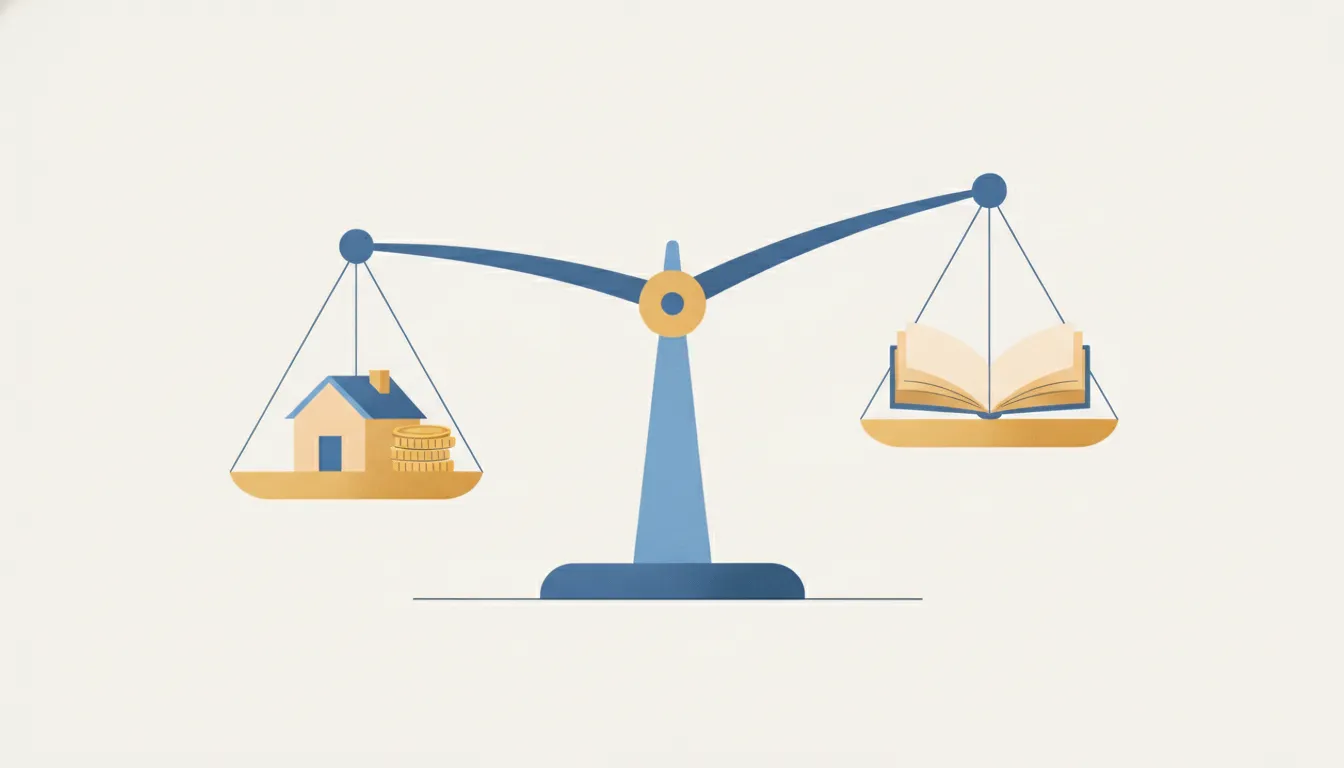
Most households look at their money one piece at a time. The mortgage statement sits in one place, the retirement account in another, and the estimated value of the home lives on a phone app. Each number tells part of the story. Put them side by side and a clearer picture appears. This article walks through a simple three-part way to do that, and explains why the mortgage often deserves special attention.
Key takeaways
- A three-sided balance sheet keeps debts, home equity, and savings and investments apart, because each one behaves differently.
- For most homeowners the mortgage is the largest and longest-running debt, so its rate, balance, and remaining term carry a lot of weight.
- Home equity counts as wealth on paper, but it is hard to spend without selling the home or borrowing against it.
- A modest cash cushion helps keep a surprise bill from turning into new debt on the liability side of the sheet.
- The Rule of 72 (72 divided by an annual rate) gives a quick estimate of how long a balance takes to double, whether it is a debt or a savings account.
Three sides of one picture
A traditional balance sheet has two sides: what a household owns and what it owes. A three-sided version splits the "owns" column in two, because a home behaves differently from savings and investments.
- Liabilities: the mortgage, car loans, student loans, credit cards, and anything else owed.
- Real estate: the home itself, and the equity in it (its estimated value minus what is still owed on it).
- Assets: cash, savings, retirement accounts, and other investments.
Why separate the home from the rest? Because you can't sell one bedroom to cover a car repair, and you can pull money out of a savings account in a day. Keeping the groups apart makes those trade-offs visible instead of burying them in one total.
The liability that usually comes first
For most homeowners the mortgage is the largest debt and the one that lasts the longest. Small differences in rate or term repeat every month for years, so they add up in ways that are easy to miss.
Three facts describe almost any mortgage: the interest rate, the remaining balance, and the remaining term. Together they determine how much of each payment goes to interest and how much reduces the balance, a pattern shown on an amortization schedule.
The rate itself also has a history. Many households hold loans whose rates were set years ago, in a very different market. Whether today's rates sit above or below the rate on an existing loan changes how a household weighs options such as moving or refinancing. For example, a household with an older, lower rate may feel reluctant to give it up, while one with a higher rate may follow the market more closely. Neither position is right or wrong. They are just different starting points, and refinancing generally comes with its own costs.
Loans also end for ordinary reasons. Relocations, family changes and other life events are common reasons that a mortgage is paid off long before its final scheduled payment.
The home: valuable, but hard to spend
For many families the home is the single largest piece of wealth. That equity is real, but it is not cash. Reaching it usually means selling the home or borrowing against it, and both choices carry costs and risks.
Home values can also move in either direction, and the pace differs a great deal from one local market to the next. Affordability depends on several things at once: prices, interest rates, local incomes, and how quickly wages grow compared with housing costs. The gap between the cost of buying and the cost of renting changes over time and varies by place, which is why national headlines rarely describe any one household's situation.
Assets and the cushion in between
On the savings side, the first layer is often the least exciting: cash that is easy to reach. Without a cushion, a surprise expense can land on a credit card, which pushes the liability side of the sheet up again. The Consumer Financial Protection Bureau notes that households without savings may turn to credit cards, loans or retirement funds when unexpected costs arrive, which can lead to debt that is harder to repay.
Beyond the cushion sit retirement and investment accounts. A familiar idea in investing education is that time in the market tends to matter more than trying to pick the right moment. Broad markets have trended upward over long stretches of history, with sharp declines along the way. Past patterns do not promise future results, and every investment carries the possibility of loss.
A quick feel for compounding: the Rule of 72
Interest compounds on both sides of the sheet. A handy shortcut for sensing how fast is the Rule of 72: divide 72 by the annual rate, and the result is the approximate number of years it takes a balance to double.
Here are some hypothetical examples:
- At 3%, a balance doubles in roughly 24 years (72 ÷ 3).
- At 6%, roughly 12 years (72 ÷ 6).
- At 24%, which is in the range of some credit card rates, roughly 3 years if nothing were paid down.
It is an estimate that works best for moderate rates, but it shows why the same math can feel helpful on a savings balance and heavy on a debt.
Questions a household might ask
A balance sheet is only a snapshot, but it can prompt useful questions:
- What are the rate, balance, and remaining term on the largest debt?
- How much of household wealth sits in the home compared with accounts that can be reached quickly?
- If a surprise bill arrived this month, where would the money come from?
- How do the interest rates on each debt compare with the rates on savings?
There are no universal right answers. The value of the exercise is seeing all three sides together, in plain numbers, before making decisions.
Nonprofit educators such as the National Institute of Financial Education offer neutral material on both the benefits and the liabilities of owning a home. For anyone building their first balance sheet, the goal is not a perfect picture. It is a clearer one.
Common questions
What is a three-sided balance sheet?
It is a way of organizing household finances into three groups: liabilities (what is owed), real estate (the home and the equity in it), and other assets (savings, retirement and investment accounts). Separating the home from other assets makes its different traits easier to see.
Why is a home treated separately from savings and investments?
A home is both a place to live and a store of value, and it is hard to turn into cash in small pieces. Savings accounts are far more flexible, so grouping them together can hide that difference.
What does the Rule of 72 tell you?
It estimates how many years it takes a balance to double at a fixed annual rate by dividing 72 by the rate. It is an approximation, not an exact figure, and it works in both directions: for interest earned and for interest owed.
Explore your next step
Sources and further reading
From the Borrow Smart newsletter
NIFE provides general financial education. LendsightAI and Debt Done Date are separate for-profit partners; optional services may have a fee.