
Small Savings, Long Time: Why Compounding Starts Slow
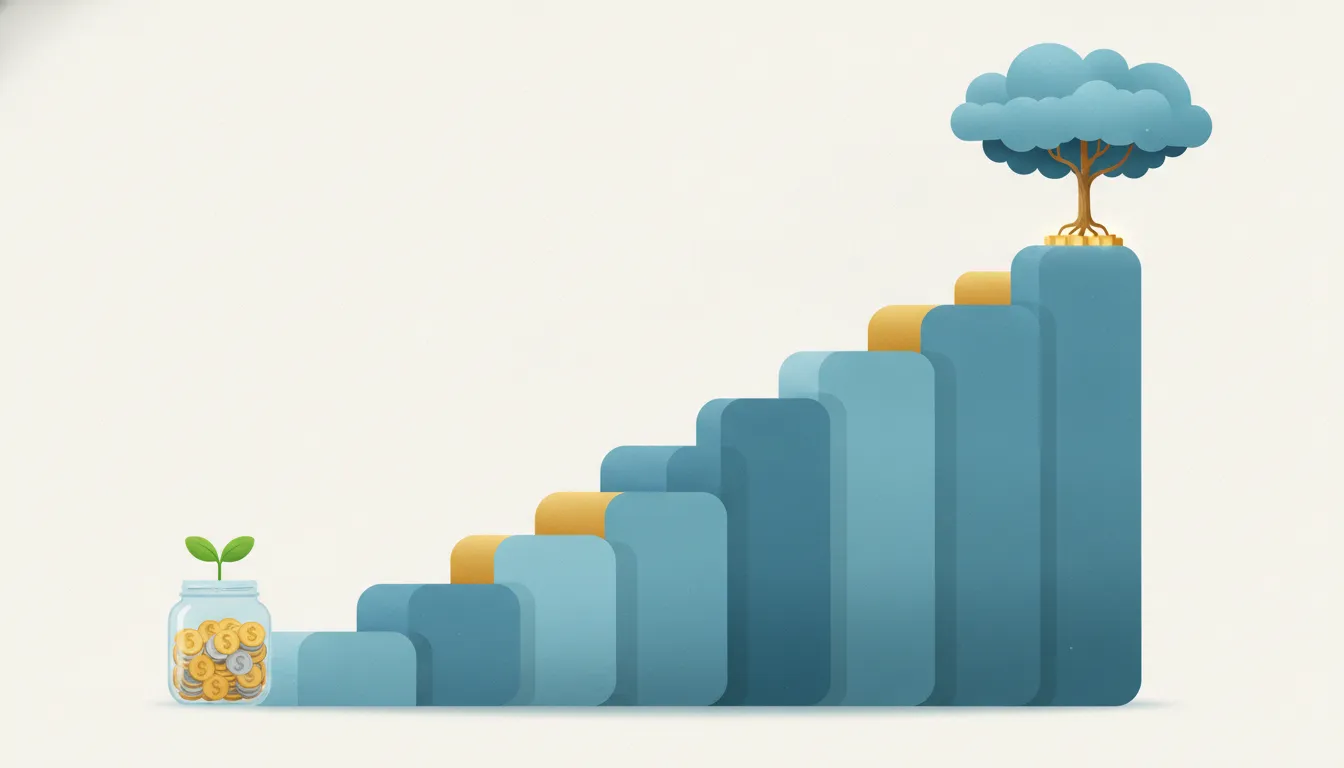
Most people have heard that compound interest is powerful, and most are not sure what it looks like in practice. The honest picture is a slow start. The first years of steady saving can feel underwhelming, and the later years do surprisingly large amounts of the work. Understanding that shape helps explain why starting date often matters as much as the deposit amount.
Key takeaways
- Compound interest means earning interest on the money you saved and on the interest you have already earned.
- In a hypothetical $200 monthly deposit at an assumed 5 percent, the balance after 10 years is only about $7,000 above what was put in.
- The same hypothetical deposit grows to about $305,000 after 40 years, with most of that coming from growth rather than deposits.
- Waiting ten years to start can mean needing a monthly deposit more than 80 percent larger to reach the same hypothetical balance.
- Interest rates, fees, taxes and inflation change real outcomes, so a calculator is a way to explore possibilities rather than predict a result.
What compounding means
The Consumer Financial Protection Bureau describes compound interest as earning interest on the money you have saved and on the interest you have earned along the way. Its example is $1,000 earning 5 percent a year. After one year the balance is $1,050. In the second year the interest is figured on $1,050 rather than $1,000, so the balance reaches $1,102.50.
That extra $2.50 is small, which is the point. The effect is gentle at first and stronger as the balance grows.
A hypothetical monthly deposit
Consider a household that deposits $200 a month and earns an assumed 5 percent a year, compounded monthly. The 5 percent is an illustration, not a forecast, and no particular account is promised to earn it.
- After 10 years the balance would be about $31,056, of which $24,000 is money deposited. Growth adds only about $7,000.
- After 20 years it would be about $82,207, against $48,000 deposited.
- After 30 years it would be about $166,452, against $72,000 deposited.
- After 40 years it would be about $305,204, against $96,000 deposited.
Look at the last ten years. Between year 30 and year 40, the balance rises by roughly $138,750, even though only $24,000 of that is new deposits. The rest is growth on a balance that has had time to build. The first decade barely resembles the last.
What a different rate or a late start does
Rates matter too. With the same $200 a month for 40 years, an assumed 3 percent gives about $185,000, and an assumed 7 percent gives about $525,000. Real rates vary, and higher potential growth generally comes with more risk of loss.
Starting date matters as much. Suppose a second household begins ten years later and saves for 30 years instead of 40. To reach the same $305,000 at the same assumed 5 percent, it would need to deposit about $367 a month, more than 80 percent more than the first household. Time did a job that extra money has to replace.
None of this ignores real life. Many people cannot start early because of rent, student loans or a young family. The comparison is meant to show what time is worth, not to suggest that anyone who started late has missed out. Smaller steps taken now still count.
It runs in both directions
The same arithmetic applies to money owed. Interest on a balance can build on itself, which is why a high-rate balance left alone can grow faster than expected. Many households find it useful to ask, at the same time, what they are compounding in their favor and what is compounding against them.
Making the future visible
A related idea is to picture the household in later life and ask what it will need. Housing costs, health care, help at home and time with family all have a price. Writing those down turns a vague wish to save into a target to work toward.
Questions to try:
- If I stopped working at a given age, what would my monthly costs be, and how much would come from sources other than savings?
- What can I deposit every month without strain, and could the amount rise a little each year?
- Could the deposit happen automatically, so it does not depend on remembering?
- What debts at high rates are compounding against me?
- How would my plan change if the rate were two points lower?
The Securities and Exchange Commission's Investor.gov offers a free compound interest calculator where you can enter a monthly contribution, a number of years and an estimated rate, and see how the results change when you adjust each one. The outputs depend on your assumptions, and they leave out taxes, fees and inflation, so they are a way to explore possibilities rather than predict one.
Common questions
Why does compounding feel so slow at the start?
In the early years the balance is small, so the interest it earns is small too. As the balance grows, each year's interest is calculated on a larger base, and the added growth becomes noticeable.
Is it better to start early with a small amount or wait and save more?
In a hypothetical example, starting ten years earlier needed a much smaller monthly deposit to reach the same balance. Real results depend on rates, fees and how steadily a person can save, so the comparison is an illustration.
Does compound interest also work against borrowers?
Yes. Interest on a balance owed can build on itself in a similar way, which is one reason high-rate debt can grow quickly if it is not paid down.
Explore your next step
Sources and further reading
From the Borrow Smart newsletter
NIFE provides general financial education. LendsightAI and Debt Done Date are separate for-profit partners; optional services may have a fee.