
How a Rate Change Reshapes the Home a Payment Can Buy
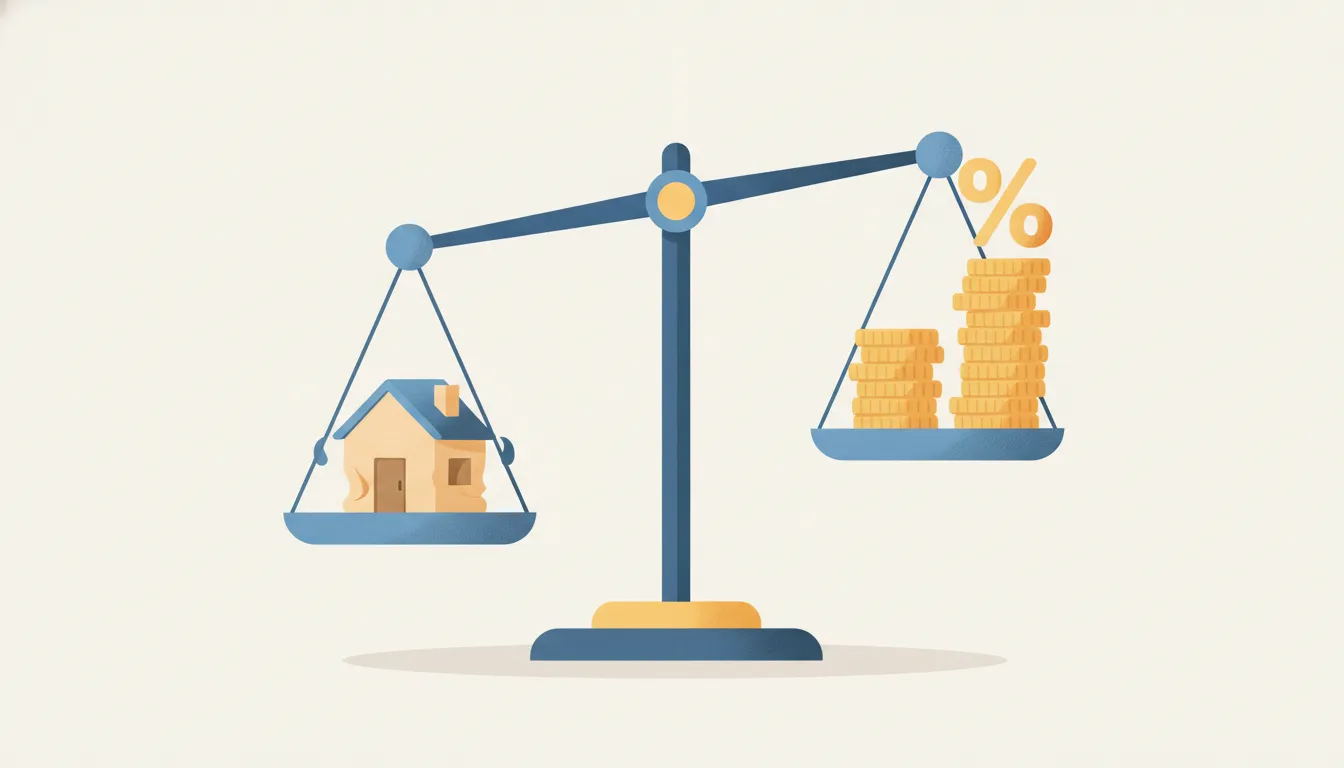
A mortgage payment does not buy the same house when interest rates change. For a household that has settled on what it can comfortably pay each month, a rate increase often means a smaller loan, and sometimes a smaller home. This article uses hypothetical numbers to show how that works, and why talk of appreciation deserves some caution.
Key takeaways
- When interest rates rise, a fixed monthly payment supports a smaller loan, so a household may find itself looking at smaller homes than it expected.
- In a hypothetical 30-year loan, moving from a 4% to a 7% rate cuts the amount a $2,000 principal-and-interest payment can borrow by more than $100,000.
- Higher rates mean more of the early payments go to interest rather than to reducing the balance.
- Appreciation can offset some of the cost of owning compared with renting, but it is never guaranteed and can turn negative.
- A larger purchase magnifies both gains and losses in home value, so a lower price tag also means less exposure to price swings.
Same payment, different price
Imagine a household that has set a budget of $2,000 a month for principal and interest on a 30-year fixed-rate loan. To keep things simple, this example ignores taxes, insurance, and the down payment. In practice, as the Consumer Financial Protection Bureau explains, a total monthly mortgage payment usually includes costs such as homeowners insurance and property taxes on top of principal and interest.
- At a 4% rate, that payment supports a loan of about $419,000.
- At a 7% rate, the same payment supports a loan of about $301,000.
The household's budget did not change, but its borrowing power dropped by roughly $118,000. The reverse view tells the same story:
- $300,000 loan: about $1,432 a month at 4%, and about $1,996 a month at 7%.
- $400,000 loan: about $1,910 a month at 4%, and about $2,661 a month at 7%.
Borrowing $300,000 at the higher rate costs roughly $564 more each month than at the lower one. These are illustrations, not quotes, and actual payments depend on the specific loan terms.
Why the rate matters so much
Interest is charged on the unpaid balance. On a $300,000 loan, the first month's interest is about $1,000 at 4% and about $1,750 at 7%. At the higher rate, more of each early payment goes to interest and less goes toward reducing the balance. An amortization schedule, the table that lists each payment's split between interest and principal, makes this visible month by month.
Over 30 years that early difference compounds. It is one reason a few percentage points can feel far larger than they sound.
Appreciation: a possible offset, not a promise
Comparing owning with renting means comparing everything each one costs. A renter pays rent. An owner pays interest, property taxes, insurance, and upkeep. Some comparisons also count appreciation, a rise in the home's value, as a factor that can offset part of the cost of owning.
Here is a thought experiment. Suppose a home worth $300,000 appreciates 4% in a year. That is $12,000, or about $1,000 a month on paper. A $400,000 home at the same rate would gain $16,000, or about $1,333 a month on paper.
Several cautions apply:
- The 4% is an assumption. It is not a forecast. Values in some years are flat, and in others they fall.
- It works in both directions. If that same $400,000 home lost 4% of its value, the paper loss would be $16,000.
- It is a paper gain. It becomes real only if the home is sold, and selling carries its own costs.
- A bigger price tag magnifies the swings. A smaller home carries less exposure to price changes, up or down.
What history does and doesn't say
Home prices have risen over many long stretches of US history. They have also fallen significantly at times, often around recessions or when borrowing became more expensive, and recoveries took years in some places. Local markets can behave very differently from national averages.
History is a record of what happened, not a promise of what will. It helps frame the range of possibilities, but it can't tell any one household what its own home will do.
Planning around a payment that fits
Households weighing a smaller home against a larger one tend to look at the monthly figure and at the full cost of housing, including taxes, insurance, repairs, and utilities. Some households also test their budgets by asking whether they could still manage if those costs came in higher than expected.
It is also common to hear that someone could "just refinance later" if rates fall. Some borrowers do, but there is no assurance rates will fall, and refinancing comes with closing costs and qualification requirements. A plan that depends on a future rate drop carries the risk that the drop never comes.
The takeaway
There is no single right answer for every household. The useful part of the math is seeing how sensitive the numbers are: a rate change alters what a payment can buy, and appreciation, while real in many years, is an uncertain offset. Looking at both clearly, with realistic assumptions, is a sound starting point for any housing decision.
Common questions
Why does a higher interest rate lower how much house I can afford?
A fixed monthly payment has to cover interest on the loan, and a higher rate takes a bigger share of that payment. That leaves less room to repay principal, so the same payment supports a smaller loan amount.
Does home appreciation make owning cheaper than renting?
It can offset some ownership costs when prices rise, but appreciation is uncertain and varies by location. Prices can be flat or fall, and ownership also involves costs such as taxes, insurance and maintenance.
Can a mortgage be refinanced if rates fall later?
Some borrowers refinance when rates drop, but there is no guarantee rates will fall. Refinancing also involves closing costs and qualification requirements, so it is not automatic.
Explore your next step
Sources and further reading
From the Borrow Smart newsletter
NIFE provides general financial education. LendsightAI and Debt Done Date are separate for-profit partners; optional services may have a fee.