
Rent or Own? Compare the Full Cost of Housing Over Time
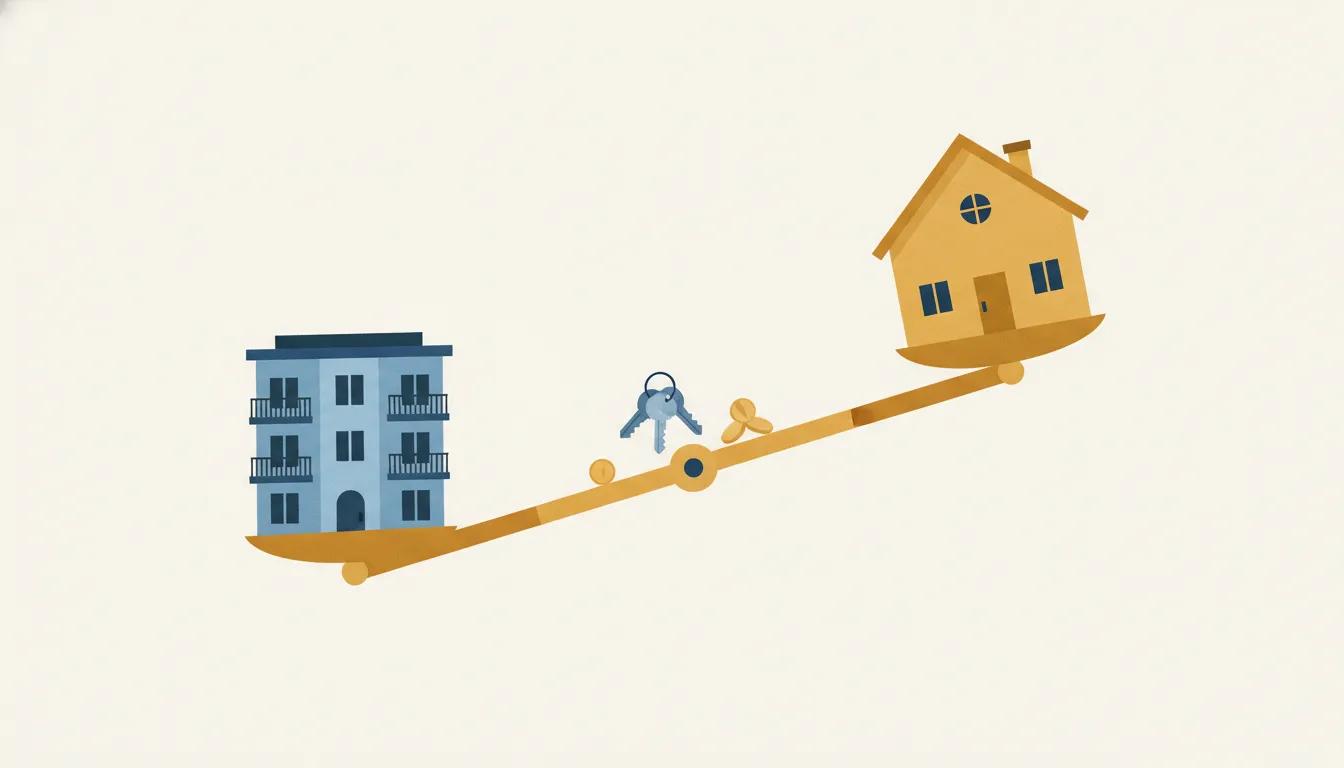
Everyone who leaves a parent's home pays for housing in one form or another. Renters pay a landlord, whose rent helps cover the property's own loan, taxes and upkeep. Owners pay a lender, a tax office, an insurer and the repair bills directly. So the question is rarely whether to pay for a place to live. It is which arrangement fits the next several years of a household's life. A useful answer starts with the total cost over the time a household expects to stay, not just the monthly payment.
Key takeaways
- Renters and owners both pay for the same underlying costs of a property, but owners pay them directly and renters pay them through the rent.
- A fair comparison looks at total cost over the years a household expects to stay, not just the monthly payment.
- In a hypothetical seven-year example, owning cost more than renting if the home did not rise in value and less if it rose 3 percent a year.
- In the same example, a two-year stay favored renting even with 3 percent growth, because buying and selling costs have little time to spread out.
- Owning brings exposure to price changes, which can help or hurt, while renting brings exposure to rent changes at renewal.
The same bills, under different names
A rental price bundles several costs into one number. A purchase spreads the same costs across several bills. The Consumer Financial Protection Bureau points out that when you own, you are responsible for maintenance and repairs, and that property taxes, insurance and utilities may cost more than they would as a renter. It also notes that buying and selling involve many fees, taxes and commissions, so a household generally wants to stay long enough to make those costs worthwhile.
That last point is the heart of the comparison. Renting is the more flexible arrangement. Owning has higher entry and exit costs that need years to spread out.
A list of what to count
Owners often count:
- Mortgage principal and interest.
- Property taxes and homeowner's insurance.
- Maintenance and repairs, which arrive unevenly.
- Possible association fees and mortgage insurance.
- Closing costs on the way in and selling costs on the way out.
- What the down payment could have done elsewhere.
Renters often count:
- Rent, which may change at renewal.
- Renter's insurance and utilities.
- Moving costs if the lease ends.
- The absence of equity, in exchange for fewer surprises and more flexibility.
A hypothetical seven-year comparison
Consider a household choosing between renting at $2,400 a month, with rent rising 3 percent a year, and buying a $400,000 home with 20 percent down. Assume a 30-year loan of $320,000 at 6.5 percent, so principal and interest is about $2,023 a month. Add property tax at 1 percent of value a year, insurance of $1,800 a year, maintenance of 1 percent of value a year, closing costs of 3 percent and selling costs of 6 percent.
Over seven years, renting costs about $221,000 in total. Owning, after subtracting what is left from a sale once the loan is repaid, comes out like this:
- If the home's value is unchanged, owning costs about $245,000.
- If it rises 3 percent a year, owning costs about $164,000.
- If it falls 2 percent a year, owning costs about $291,000.
Now shorten the stay. At 3 percent annual growth, a two-year stay costs about $58,000 renting and about $74,000 owning. The same home that came out ahead over seven years does not over two, because the costs of buying and selling had little time to spread out.
These numbers are illustrations, not forecasts. They leave out what the down payment and closing costs could have earned elsewhere, income tax effects, utility differences and moving costs, and real quotes would differ. The point is how much the answer swings with the years of the stay and the direction of local prices.
What moves the answer
Local rents and prices matter more than national headlines. The Census Bureau publishes quarterly vacancy rates for rental housing. Vacancy data can help describe local rental availability, but it does not predict what a particular landlord will charge or how rents will change. Compare current listings and lease terms in the area you are considering.
A fixed-rate mortgage has an interest rate that is set when the loan is made, but taxes, insurance and repairs can still change. A renter faces the opposite pattern, with a payment that can reset at each renewal.
House and home, and what a budget is for
It can help to separate the house, the physical property with its financial features, from the home, the daily experience of living in it. A renter can build a warm home without carrying the price risk of the house. An owner gets both and also takes on the risk of values moving either way.
It is also worth asking how much of a housing choice is about space and needs and how much is about status. Stretching a budget for a bigger or fancier property raises every cost on the list above.
Questions to ask before deciding
- How many years do we realistically expect to stay?
- What is the full monthly cost of owning, including taxes, insurance and a repair allowance, compared with the rent?
- How much cash would remain after the down payment, closing costs and moving?
- How would we handle a drop in local prices, or a year of big repairs?
- How much do rents here tend to change at renewal?
- Which space and location needs are essential, and which are preferences?
Common questions
Is renting just throwing money away?
Rent pays for a place to live and for the landlord's costs of the property, much as an owner's payments, taxes, insurance and repairs pay for the same things. What differs is that an owner may build equity and takes on price risk, while a renter keeps flexibility and avoids buying and selling costs.
How long do you need to stay in a home for buying to make sense?
There is no universal number. The Consumer Financial Protection Bureau notes that buying and selling involve many fees, taxes and commissions, so a household generally needs to stay long enough to make those costs worthwhile. The break-even point depends on local prices, rents and loan terms.
What costs of owning are easy to overlook?
Property taxes, homeowner's insurance, maintenance and repairs, possible association fees, and the costs of buying and later selling. Rent bundles many of these into one number, so they can be less visible when comparing.
Explore your next step
Sources and further reading
From the Borrow Smart newsletter
NIFE provides general financial education. LendsightAI and Debt Done Date are separate for-profit partners; optional services may have a fee.