
Why Losses Loom Large: Loss Aversion in Household Money Choices
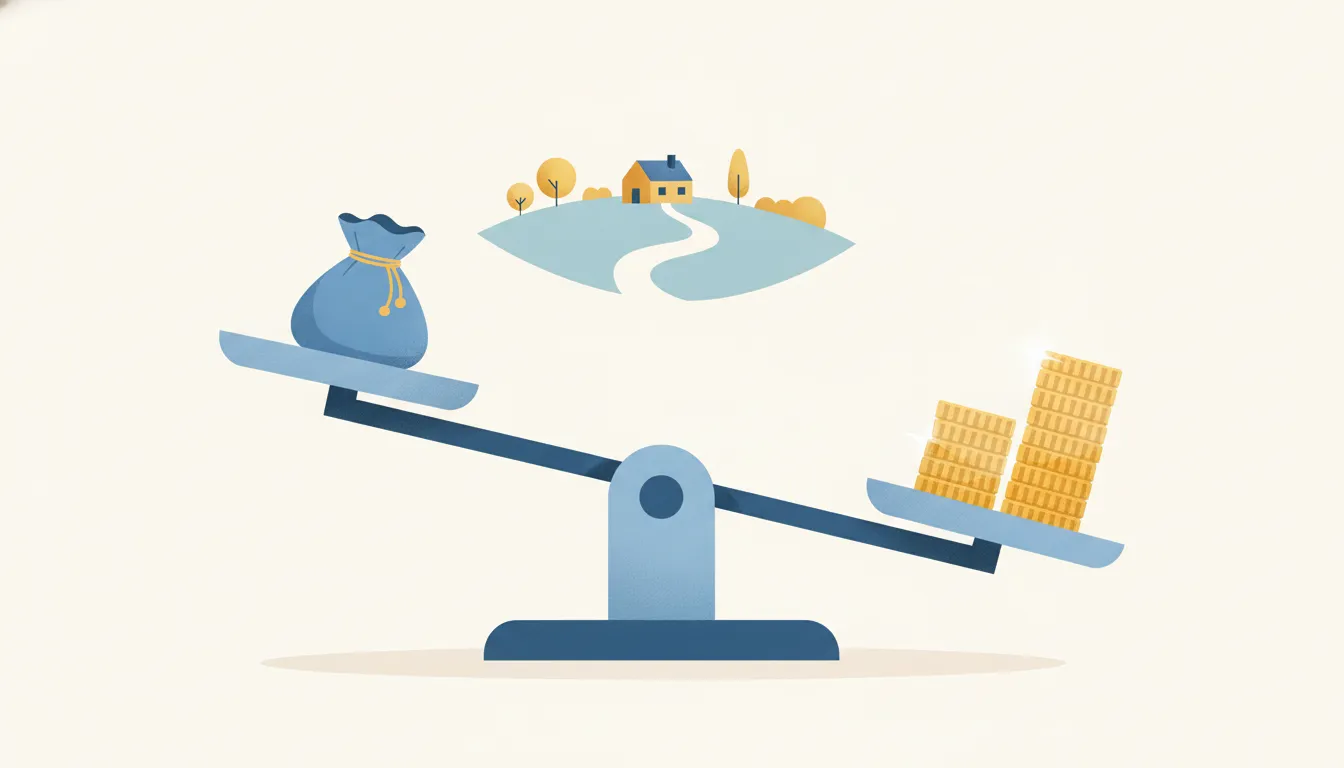
Imagine two households facing the same choice. One hears "you will pay $4,000 now and save $120 a month." The other hears "if you do nothing, you will keep paying $120 a month more than you need to." The facts are the same, but many people react differently. The first group tends to hesitate. The question worth asking is why a sure cost today can feel heavier than a larger gain that arrives slowly, and what a household can do to check its own reactions before a decision.
Key takeaways
- Loss aversion is a tendency to prefer avoiding losses much more strongly than acquiring gains, according to a Federal Reserve Board review of behavioral research.
- The same facts can lead to different choices depending on whether they are described as a loss or as a gain.
- A one-time cost with a delayed payoff, such as refinancing closing costs, can feel heavier than the same dollars received slowly over years.
- Researchers debate how robust some loss aversion findings are, so the idea works best as a prompt to check your reasoning, not as a rule about people.
- Setting criteria in writing before a stressful moment and restating a choice in total dollars over a time horizon are two ways households test their own reactions.
What loss aversion means
Loss aversion is a term from behavioral research. A Federal Reserve Board economist's review of that research describes it as a tendency to prefer avoiding losses much more strongly than acquiring gains. People tend to judge outcomes against a starting point, so a result below that point is felt as a loss, even if the overall picture is positive.
The same review gives a famous illustration of framing. People tend to prefer a program that saves 90 out of 100 lives over one that loses 10 out of 100, even though the two are equivalent. The words changed, not the facts.
A caution belongs here. The review also discusses an experiment in which a gap that was widely taken as evidence for loss aversion, the endowment effect, disappeared when the procedures were changed. Researchers continue to debate how strong and how general the effect is. It is better treated as a prompt for self-checking than as a rule about how everyone behaves.
Where it can show up in a household
Paying a cost to save later. Refinancing, installing efficient equipment and paying down a loan can all involve a known cost now and benefits spread over time. Take a hypothetical household weighing a refinance with $4,000 in closing costs that would lower the payment by $120 a month. The break-even is about 33 months, since $4,000 divided by $120 is roughly 33. Whether that is attractive depends on how long the household expects to keep the loan, whether the rate or term changes, and what else the money could do. The point here is that the $4,000 is visible on a single day, while the savings arrive in small pieces that are easy to overlook.
Reacting to a drop. After a fall in the value of a home or an investment, some people want to act quickly to stop the pain, and others refuse to look at all. Both reactions can come from the same discomfort. A household that has already decided what would make it change course tends to have an easier time telling a plan from a reflex.
Holding on to the status quo. Staying with a current loan, account or arrangement can feel safe because switching creates a risk of regret. Sometimes staying is the right call. The check is whether it is chosen or merely avoids the feeling of a possible loss.
Questions that test the reaction
Some households find it useful to ask a few questions before a decision:
- If this choice were described as a gain instead of a loss, would my answer change?
- What is the total in dollars, over a time horizon I can name, of acting and of not acting?
- What would I need to see to change my mind, and did I decide that before I got upset?
- Could I absorb the loss I am worried about, or would it truly harm the household?
- Would a neutral person, such as a housing counselor or an advisor, read these numbers the same way?
None of these questions says that risk is good or that caution is bad. A household with a thin cash cushion has good reason to be wary of losses. What helps is knowing whether the caution is reasoned.
Putting numbers on both sides
A simple habit is to write the choice in two columns. In one, list what acting costs now and later. In the other, list what not acting costs now and later, including the quiet costs such as a payment that stays higher than it has to be. Then look at both over the same period. This does not remove the feeling of loss, but it puts the feeling next to the arithmetic.
It also helps to separate the decision from the moment. A choice made when markets, headlines or a bill are loud may look different a few days later. Writing down criteria in advance gives a household something to return to.
What it adds up to
Feeling pain at a loss is human, and it can protect a household. The goal is not to remove it but to understand when it is steering. A sure cost now and an uncertain gain later are two sides of the same decision, and giving both equal attention is part of making a choice you can stand behind.
Common questions
What is loss aversion in simple terms?
It is the tendency to feel the pain of a loss more strongly than the pleasure of an equal gain. A Federal Reserve Board review describes it as preferring to avoid losses much more strongly than acquiring gains.
Does loss aversion mean avoiding risk is always a mistake?
No. Avoiding risk can be sensible when a household cannot absorb a loss. The point is to notice when fear of a loss, rather than the numbers and goals, is making the choice.
Is loss aversion settled science?
Not entirely. The same review notes that some experiments on related ideas, such as the endowment effect, have not held up when the procedures were changed, so researchers continue to debate how strong and general the effect is.
Explore your next step
Sources and further reading
From the Borrow Smart newsletter
NIFE provides general financial education. LendsightAI and Debt Done Date are separate for-profit partners; optional services may have a fee.